Executive Summary
The global mobile video surveillance market is growing rapidly, projected to rise from $2.78 billion in 2025 to $4.00 billion by 2030. Antaira's purpose-built industrial networking solutions address the power, connectivity, and environmental challenges that mobile surveillance trailers face in real-world deployments.
The global mobile video surveillance market is growing rapidly, projected to rise from $2.78 billion in 2025 to $4.00 billion by 2030. This growth signals a major shift as temporary, rapid-deployment security solutions evolve from niche applications into mission-critical infrastructure.
As demand accelerates, so does the strain on the networks that keep these systems connected. For mobile surveillance trailers, a reliable, high-performance network backbone has become increasingly critical.
The forces driving mobile surveillance growth include heightened security concerns, the ability to eliminate costly permanent infrastructure, and cost advantages over traditional manned security.
Mobile security trailers, for example, can provide 24/7 protection at 60–90% less than the cost of a live night guard, while offering broader coverage, eliminating blind spots, and avoiding operational limitations associated with staffing, including breaks, absences, and workers' compensation exposure.
Power Challenges In Mobile Deployments
Mobile surveillance trailers face a unique power challenge. As self-contained units, they must deliver reliable, continuous power to multiple devices mounted on telescopic masts that can reach 20 to 40 feet high, often while running entirely on solar energy stored in onboard battery banks.
A typical trailer relies on four to eight deep-cycle batteries to sustain off-grid power. Meanwhile, cameras, PTZ mechanisms, IR illuminators, and wireless transmission equipment together draw substantial wattage, even though the available power is generally capped at 24VDC, a voltage dictated by battery systems built for solar charging cycles.
Traditional networking approaches can fall short in this environment. Standard enterprise switches designed for climate-controlled server rooms may not withstand the temperature extremes, vibration, and power fluctuations inherent to trailer-mounted applications.
The challenge intensifies with 802.3bt (PoE++) requirements. PSE input voltage for PoE++ switches typically falls in the 50V–57V range to supply up to 60W (Type 3) or 90–100W (Type 4) per port. Solar-powered trailers running at 24VDC do not natively provide this voltage.
Off-the-shelf PoE injectors can further complicate installations by creating additional cabling and potential points of failure across the network.
The solution requires industrial networking equipment purpose-built for harsh environments and optimized for the low-voltage DC power systems common in solar installations.
Engineering Excellence: LMP-1204G-SFP-bt-24-T
Antaira has engineered the LMP-1204G-SFP-bt-24-T managed industrial PoE switch for mobile surveillance trailer applications. Unlike adapted enterprise equipment, the switch is designed for the conditions mobile trailers encounter.
The switch operates directly from the 24VDC input standard in solar-powered trailers and delivers up to 100W per port via PoE++, with a total PoE power budget of 180W at 24VDC input.
12-Port Configuration
- Four 10/100/1000Tx ports supporting IEEE 802.3bt (PoE++) at up to 90–100W each.
- Four 10/100/1000Tx ports supporting IEEE 802.3af/at at up to 30W each.
- Four 100/1000 dual-rate SFP slots for fiber uplink and wireless backhaul connectivity.
The four PoE++ ports can independently power high-draw PTZ cameras, while the af/at ports can handle lower-power devices such as fixed cameras or wireless access points.
The equipment consolidates power and data delivery into a single compact, DIN-rail-mountable unit, eliminating the need for multiple external power supplies.
This can simplify trailer design by allowing system integrators to consolidate camera power and data delivery onto one switch. The unit is also designed to operate across temperatures from -40°F to 167°F.
For surveillance trailers deployed in environments ranging from Arizona summers to Canadian winters, industrial temperature ratings can be an important requirement.
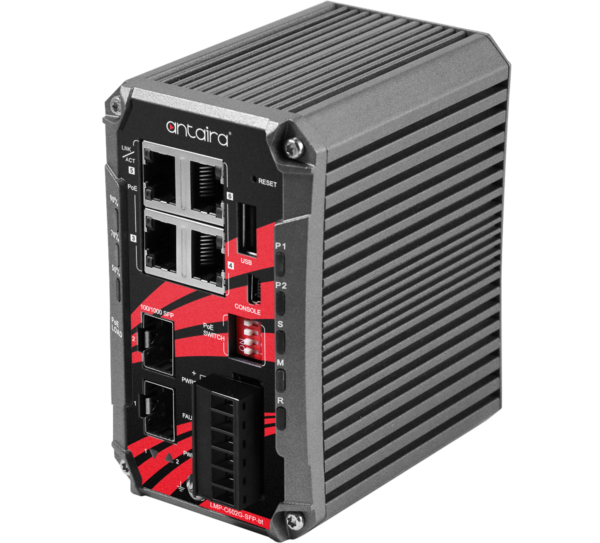
Compact Power: LMP-C602G-SFP-bt-T-V2
For integrators prioritizing space efficiency and front-panel accessibility, Antaira offers the LMP-C602G-SFP-bt-T-V2 switch.
The compact six-port managed switch features four 802.3bt PoE++ ports supporting up to 90W each, along with two SFP fiber slots. It is designed to support mobile trailer applications when Antaira V6.2 firmware is installed.
The LMP-C602G-SFP-bt-T-V2 has a native power input of 48–55VDC. Paired with Antaira's DTD-360-0953-T power booster, the combination steps 24VDC solar input up into the switch's operating range and unlocks its full 240W PoE power budget.
This provides enough capacity to power a trailer's camera and sensor load from an integrated solution.
The front-connection design also supports field maintenance. When a trailer requires camera reconfiguration or troubleshooting, technicians can access connections from the front panel without removing the switch from its mounting or working around cramped enclosures.
In mobile deployments where serviceability directly affects uptime, this design can simplify maintenance.
Why Industrial-Grade Networking Matters
The difference between consumer-grade and industrial networking equipment becomes particularly important in mobile surveillance applications.
A trailer deployed at a construction site might experience temperature swings of 50°F in a 24-hour period, vibration from nearby equipment, and power fluctuations caused by varying solar charge cycles and battery states.
Antaira's industrial switches incorporate hardened components, conformal coating options, redundant power inputs, and power management designed to adapt to varying input voltages.
Managed switch capabilities enable remote monitoring of power consumption per port, automatic PoE power allocation, and VLAN segmentation for multi-camera networks. These capabilities can be important when surveillance infrastructure operates unmanned for extended periods.
Real-time cellular transmission of HD video also requires consistent network performance. A dropped connection during a security incident can undermine the purpose of a surveillance trailer.
Antaira's industrial-grade managed switches provide Quality of Service (QoS) controls, bandwidth management, and fault detection designed to help critical video streams maintain priority while background analytics and firmware updates are running.