
Executive Summary
Genetec released education-specific findings from its 2026 State of Physical Security Report, highlighting how North American K-12 and higher education institutions are prioritizing improved situational awareness, faster incident response, and unified security systems amid budget pressures.
Key Findings
Campus Safety And Visibility Remain Top Priorities
Education institutions are primarily using physical security data to monitor and respond to incidents across campus. Monitoring and responding to incidents on campus was cited by 86% of higher education and 79% of K-12 respondents, making it the most common application overall.
77-80%
Use security data to manage building access for students, staff & visitors
76-80%
Use security data to investigate student or staff conduct issues
Emergency preparedness also remains a priority. More than half of higher education respondents (54%) and 59% of K-12 respondents said physical security data supports emergency response planning and drills, reinforcing the need for real-time visibility and coordinated response during critical situations.
Together, these findings point to a need for more unified security operations, where video, access control, and other security data can support faster understanding and response across classrooms, buildings, and campus grounds.
Budget Constraints Remain The Biggest Challenge
Despite increased reliance on security technology, budget limitations and funding constraints were identified as the top challenge facing education organizations, cited by 72% of higher education respondents and 74% of K-12 respondents.
Key Challenge Identified
Budget limitations remain the #1 barrier to implementing comprehensive security solutions across both K-12 and higher education sectors.
Visibility And Situational Awareness Justify Security Investments
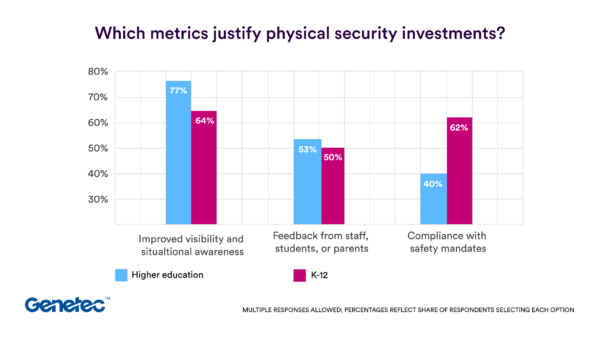
When asked which metrics are used to justify physical security investments, improved visibility and situational awareness across campus ranked highest, cited by 77% of higher education respondents and 64% of K-12 respondents.
| Justification Metric | Higher Education | K-12 |
|---|---|---|
| Improved visibility & situational awareness | 77% | 64% |
| Feedback from stakeholders | 53% | 50% |
| Compliance with safety mandates | 45% | 62% |
Compliance with district, state, or federal regulations was also a key driver, particularly in K-12, where 62% said meeting safety mandates is a primary justification for security investments.
"Education institutions are under pressure to strengthen campus safety while managing limited budgets. By unifying video, access control, and other security data into a single platform, schools can improve visibility, respond more quickly to incidents, and meet compliance requirements, all while making the most of their existing investments."
About This Report
The 2026 State of Physical Security Report from Genetec provides industry-specific insights into how organizations across various verticals—including education—are leveraging physical security technology to address evolving safety challenges. The education edition focuses specifically on the unique needs and priorities of K-12 schools, colleges, and universities in North America.
Visit Genetec.com