Executive Summary
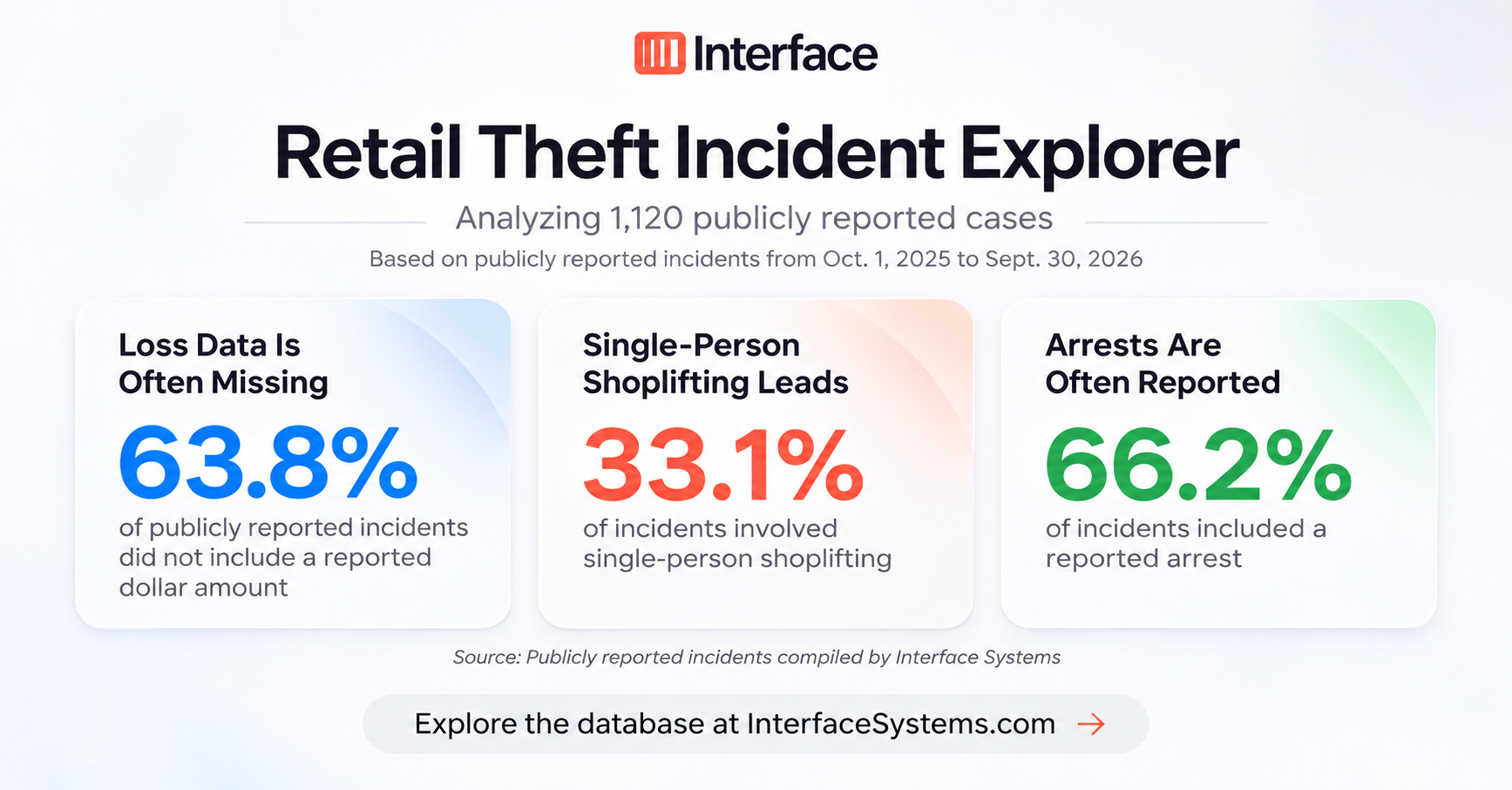
Interface Systems has launched its free Retail Theft Incident Explorer, a searchable database of 1,120 publicly reported retail theft incidents drawn from news reports and law enforcement announcements covering October 1, 2025 through September 30, 2026. Users can filter by store type, method of crime, time of day, state, and city — with key findings revealing that nearly two-thirds of incidents lack a reported dollar amount and that single-person shoplifting and organized group theft together account for more than half of all documented cases.
Interface Systems recently launched its free Retail Theft Incident Explorer, a searchable database designed to help retailers, journalists, researchers, and policymakers examine publicly documented retail theft.
The Explorer brings together 1,120 incidents drawn from news reports and law enforcement announcements, covering incidents from 1st October 2025 through 30th September 2026. Users can filter records by store type, method of crime, time of day where available, state, and city. Retail security teams can use these filters to examine similar incidents, while journalists and researchers can locate cases and source material for further investigation.
Key Findings
63.8%
Loss information is frequently missing
Nearly two-thirds of incidents lack a reported dollar amount, making it difficult to assess the financial impact of individual cases.
$485
Exact vs. estimated losses
The median loss where an exact dollar amount is quoted is $485. When the report says “about” or “more than,” the median rises to $4,000.
58%
Shoplifting & organized group theft
Single-person shoplifting accounts for 371 incidents (33.1%) and organized group theft makes up 279 (24.9%). Robbery adds 229 cases (20.4%), while after-hours break-ins account for 150 (13.4%).
27.4%
General merchandise & discount stores
These stores account for 307 incidents in the database, making them prime targets among documented cases.
66.2%
Arrests are frequently documented
An arrest was reported in 742 incidents (66.2%) of the collection. An arrest does not establish a conviction or final case outcome.
These findings describe the collection rather than national theft prevalence, state crime rankings, or a national retail theft arrest rate.
“Understanding retail theft trends is essential to helping businesses better protect their employees, customers, and assets. While many incidents go unreported, those that are documented provide valuable insight into emerging patterns, operational risks, and opportunities to strengthen loss prevention strategies. We built the Explorer to make publicly reported cases easier to examine, compare, and verify. Every record links to its source, giving retailers, journalists, and policymakers a clearer view of what is documented and where important questions remain.”
Explore the Database
The Retail Theft Incident Explorer is available for free, and Interface plans to update the database every quarter.
Open the Retail Theft Incident ExplorerAbout the Data
Sources include news reports, police and sheriff press releases, state attorney general announcements, and municipal crime blotters. The collection covers incidents from October 1, 2025 through September 30, 2026.
To qualify, a source must identify a retail store location and describe a theft committed by someone from outside the business. Employee theft is excluded. Duplicate coverage was consolidated using a store-location-and-date rule.
The database is not a representative sample of all retail theft. Its composition depends on which incidents were publicly documented and identified during collection. Missing information indicates that a detail was not reported in the source reviewed.